Prime Minister David Cameron has set out the Government’s plans for modernising public services, driven by competition, choice and greater independence for institutions.
In a speech at the RSA in London, the PM said 2011 was a critical year for the Government’s modernisation agenda.
Cameron stressed he wanted “one of the great legacies of this Government to be the complete modernisation of our public services.”
The PM said he was “incredibly optimistic about what the country can achieve” this year, and that modernisation is both a personal and political priority for him.
Cameron said: “I don’t want anyone to doubt how important this is to me.
“My passion about this is both personal and political. Personal because I’ve experienced, first-hand, how dedicated, how professional, how compassionate our best public servants are.
“And this is a political passion – and priority – of mine too. I believe that Britain can be one of the great success stories of the new decade.”
The PM hailed work already underway to modernise services by announcing that more than 140 GP-led consortia have now come forward, covering over half the country.
These consortia are using new powers to take control of NHS budgets and directly commission services for their patients.
The Government's plans for the NHS though have been denounced by six health service unions - including the British Medical Association and the Royal College of Nursing - as "potentially disastrous".
But Cameron dismissed suggestions that services could carry on as they were as "a complete fiction", insisting that change was essential.
He said: "Every year without modernisation the costs of our public services escalate. Demand rises, the chains of commands can grow, costs may go up, inefficiencies become more entrenched.
"Pretending that there is some 'easy option' of sticking with the status quo and hoping that a little bit of extra money will smooth over the challenges is a complete fiction.
"We need modernisation, on both sides of the equation. Modernisation to do something about the demand for healthcare, which is about public health.
"And modernisation to make the supply of healthcare more efficient, which is about opening up the system, being competitive and cutting out waste and bureaucracy.
"Put another way: it's not that we can't afford to modernise; it's that we can't afford not to modernise."


Latest News
-
Regulator considering MP’s claim 32 charities ‘funnelled' £28m to illegal Israeli settlements
-
Nine in ten charities using AI but few exploring its ‘true potential’, warns research
-
Evaluation reveals benefits of adding a virtual candle to online fundraising
-
Former Scope CEO to chair business group set up to tackle disability exclusion
-
Senior MP’s comparison of charity retail with vape shops criticised as 'outdated'
-
Working Families closes following ‘a sustained period of financial challenge’





Charity Times video Q&A: In conversation with Hilda Hayo, CEO of Dementia UK
Charity Times editor, Lauren Weymouth, is joined by Dementia UK CEO, Hilda Hayo to discuss why the charity receives such high workplace satisfaction results, what a positive working culture looks like and the importance of lived experience among staff. The pair talk about challenges facing the charity, the impact felt by the pandemic and how it's striving to overcome obstacles and continue to be a highly impactful organisation for anybody affected by dementia.
Charity Times Awards 2023
Mitigating risk and reducing claims
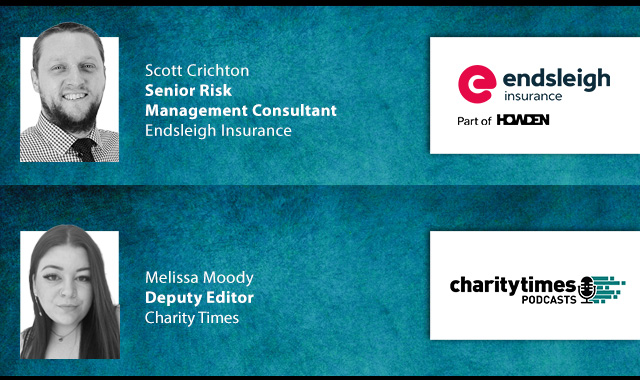
The cost-of-living crisis is impacting charities in a number of ways, including the risks they take. Endsleigh Insurance’s* senior risk management consultant Scott Crichton joins Charity Times to discuss the ramifications of prioritising certain types of risk over others, the financial implications risk can have if not managed properly, and tips for charities to help manage those risks.
* Coming soon… Howden, the new name for Endsleigh.
* Coming soon… Howden, the new name for Endsleigh.
Better Society





© 2021 Perspective Publishing Privacy & Cookies
Recent Stories